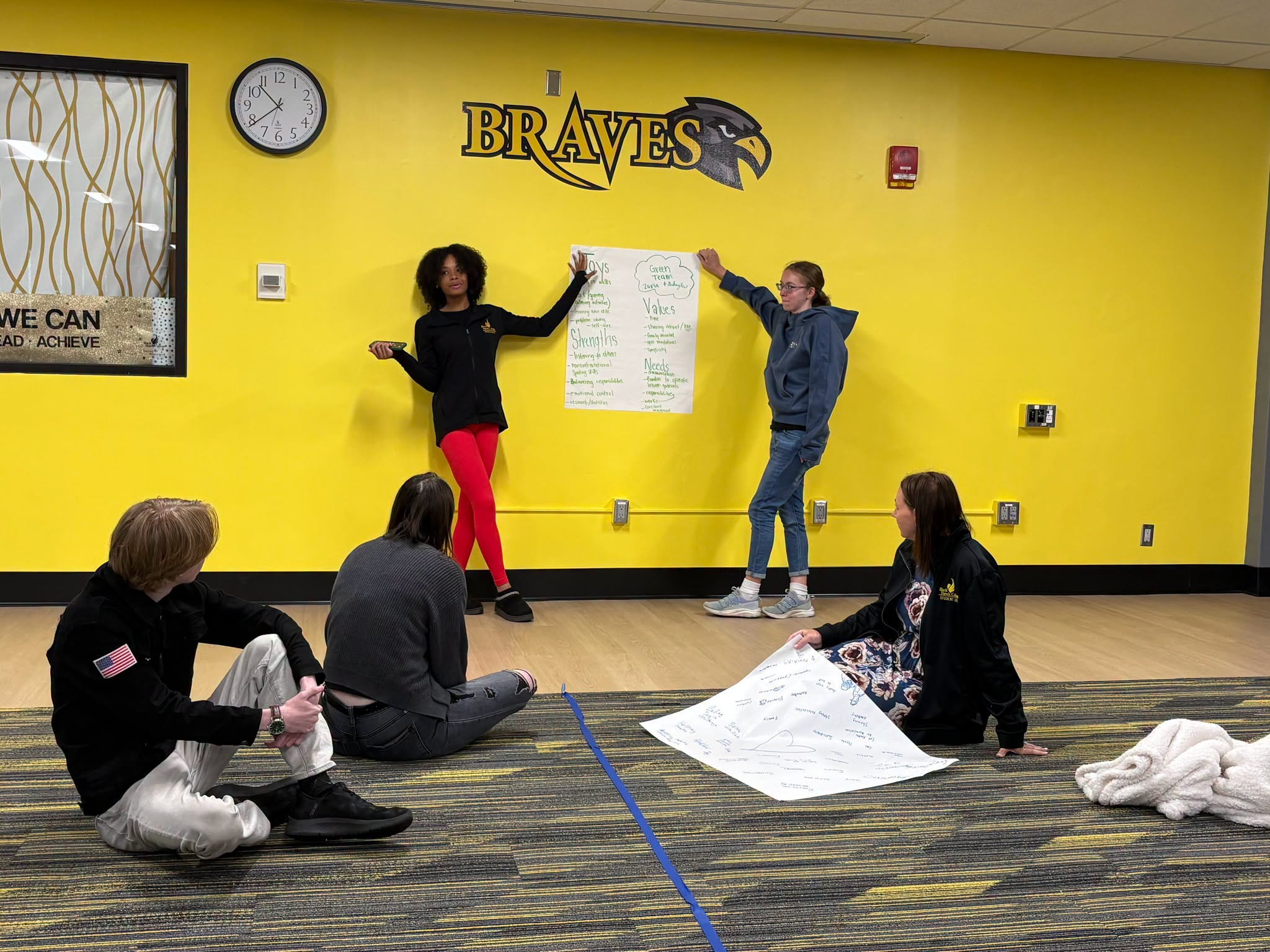
 Just about every SG has a training "retreat."
Maybe it's a few hours. Or a day. It could be on campus or at a hotel or retreat center. There's some team building, a ropes course, talk about goals. You hopefully learn everybody's name, scarf down some food, and call it a day. We're trained!
No. You're not. Not even close.
Your members represent hundreds and thousands of students, have to understand a complicated institution, work with administrators, manage money, run meetings, advocate for students, solve problems, and by the way, actually accomplish something.
You don't just get competent in one Saturday morning.
One retreat doesn't make your SG great. Or good. Or even mediocre. The average grade for SGs nationwide on ASGA's Effectiveness Test is a D-.
Training isn't an event.
It's something you do all year.
Take the SG Training QuizWhy You Train
Greatness Means Practice. A Lot of It.
Jimi Hendrix didn't burst forth from his mother's womb jamming on the guitar.
John Bonham didn't plop down behind a drum kit for a couple of minutes after school and become one of rock's legendary drummers.
Jackie Joyner-Kersee didn't become one of history's greatest Olympic track-and-field athletes by taking a jog here and there.
They trained. Practiced. Studied. Improved. Then did it again. And again.
So Why Does SG Think We're Different?
Too many SGs hold one retreat (maybe two, rarely three, almost never more) and assume their members are trained.
They're not. They're just not.
A retreat is an event. Training is a system.
Retreats are important. They're just not enough.
Why Does Everybody Else Train More Than SG?
Athletes: Train constantly. College athletes practice over and over. They practice all the time. RAs: Train extensively. Residence assistants may spend days or weeks preparing to handle policies, conflicts, emergencies, student concerns, mental-health situations. Student Government: One retreat? SG leaders may represent the entire student body and carry responsibilities that affect thousands of students. But somehow we think a retreat is enough.
Why would SG need less training?
Student leadership doesn't mean hands-off. You're in school to learn and your classes aren't taught by fellow students. They're taught by experts who know the subject, your professors. Training isn't administrators telling SG what to think or taking away your independence.
Training gives you the knowledge and skills to use that independence well.
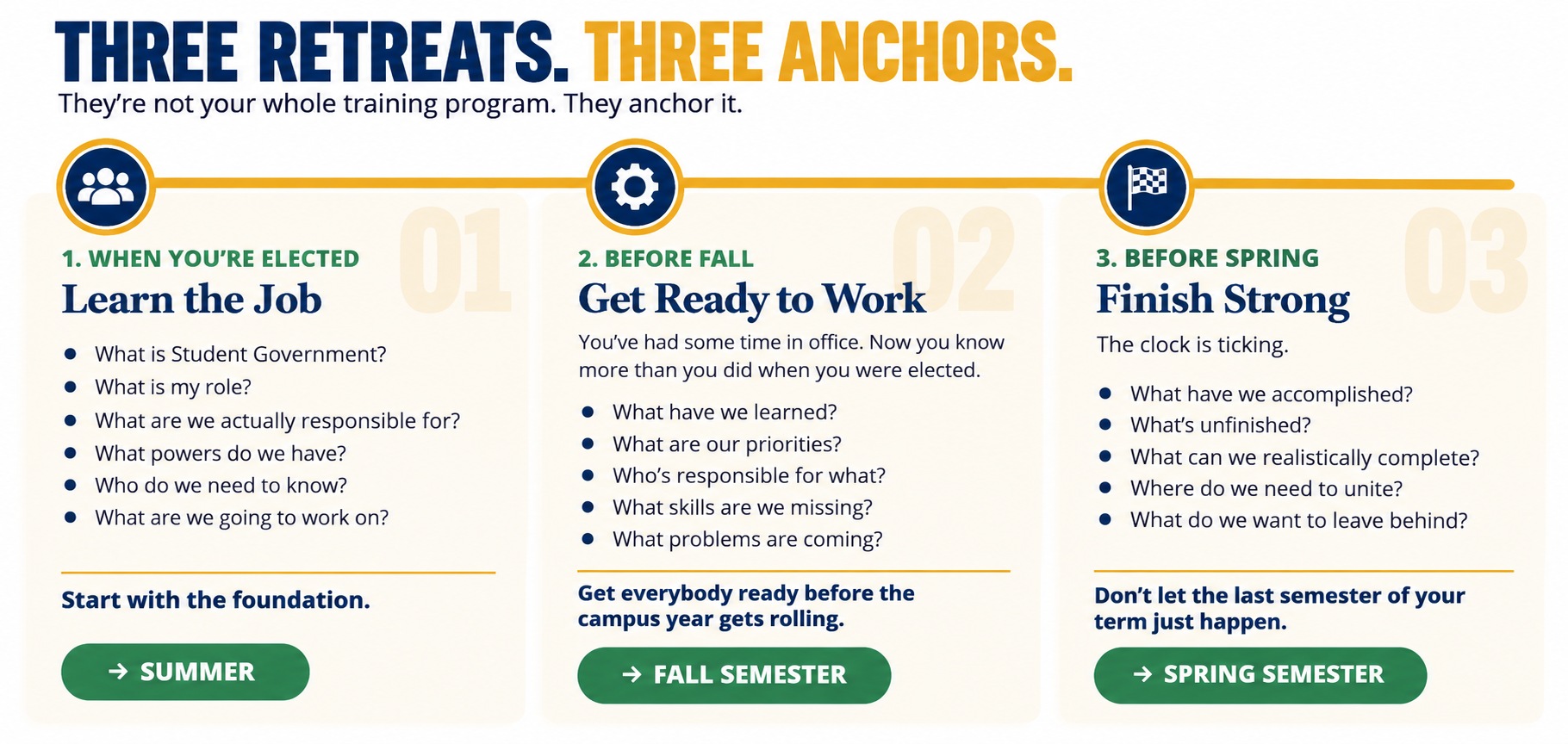
Three Retreats. Three Anchors. They're not your whole training program. They anchor it. Retreat 1, when you're elected, Learn the Job: what is Student Government, what is my role, what are we actually responsible for, what powers do we have, who do we need to know, what are we going to work on. Start with the foundation. Summer. Retreat 2, before fall, Get Ready to Work: what have we learned, what are our priorities, who's responsible for what, what skills are we missing, what problems are coming. Get everybody ready before the campus year gets rolling. Fall semester. Retreat 3, before spring, Finish Strong: what have we accomplished, what's unfinished, what can we realistically complete, where do we need to unite, what do we want to leave behind. Don't let the last semester of your term just happen. Spring semester.

15 Minutes. Every Meeting.
You already have everybody together.
Train them.
Set aside 15 minutes during regular meetings for someone from your institution to explain what their office does, what students are dealing with, and what your SG needs to understand.
Bring in your:
- Dean of Students
- Residence Life Director
- Financial Aid Director
- Campus Police
- Facilities / Plant Operations
- Registrar
- Dining Director
- Counseling Center
- IT Department
- Library
This isn't just a guest speaker. It's SG training.
Your members gradually learn how the institution really works, and who to call when students bring them a problem.
20 meetings × 15 minutes = 5 HOURS OF TRAINING
That's five additional hours without scheduling another retreat.
You Got Elected. Not Trained.
Winning an election doesn't magically teach you how to govern.
Getting appointed doesn't make you competent by osmosis either.
Someone has to help your members learn.
Put Someone in Charge of Training
Your SG has someone responsible for finance. Another handles elections. You have a communications director. Internal affairs. External affairs. You name it.
Who's responsible for making your members better at their jobs?
ASGA encourages SGs to create a Training Director position. While this is rare, it shouldn't be!
The Training Director could:
- Build the annual training plan
- Coordinate the three major retreats
- Schedule training during regular meetings
- Bring campus experts into meetings
- Identify skills members need
- Maintain training materials
- Help new members get up to speed
- Coordinate transition
- Study other SGs and bring back ideas
Maybe it's an experienced student leader. Maybe it's a student studying human resources, management, organizational leadership, education, psychology.
The position might be an academic internship, a work-study/student-employment job, or a paid or appointed SG position.
Make training so important that somebody owns it.
Yes. A Vice President of Fun.
Hartwick College has an SGA Vice President of Fun. It sounds ridiculous. But ASGA has been recommending this for years.
The job is really about morale, recognition, and relationships.
Someone got an internship? Recognize them. New job? Celebrate it. Academic accomplishment? Say something. New relationship? Congratulations. Finally got out of a terrible one? Congrats on that, too.
And get your members together somewhere other than an SG meeting. Bowling. Dinner. Pickleball. Mini golf. Game night. Whatever.
Getting to Know Each Other Is Training
When you know her as the senator who didn't finish the project, it's easy to get angry. When you actually know the person, you understand more.
Maybe they're taking 18 credits. Maybe they're working 25 hours a week. Maybe they're dealing with something at home. Maybe they're just having a rough week.
Knowing each other makes you better at working with each other. Someone should be paying attention to morale and relationships, not just agendas, budgets, and projects.
Stop Living in an SG Silo
Other SGs have created training manuals, retreat plans, transition materials, and systems you can learn from. See how they do it.
Search SG Training & Transition Manuals
Training doesn't end when your term does. Train, learn, pass it on.

Your Term Is Almost Over.
ASGA talks with SG leaders at our conferences in February who tell us they still don't really know what their job is.
Think about that.
They were elected the previous spring. They're eight or nine months into a one-year term, and just a couple of months away from leaving office.
How did this happen? Nobody really transitioned them. Maybe they got a binder. Or inherited some files. Maybe the outgoing officer spent an hour explaining things. They had to figure out the rest.
By the time they finally understand the job, it's almost time to leave.
Stop Starting Over Every Year
Every officer learns things that the next person desperately needs to know. Not just what's written in the constitution. The real job.
Build the Playbook for the Person Who Comes Next
Every officer and key member should leave something behind for the person who comes next. Tell them:
TRANSITION NOTES: [Your Position], [Your Name]
- What am I actually responsible for?
- What does a normal week look like?
- How many hours does this really take?
- What times of year get crazy?
- What deadlines absolutely cannot be missed?
- Who do I work with?
- Who are our strongest campus allies?
- Who is harder to work with, and why?
- What relationships need work?
- What makes this job frustrating?
- What mistakes did I make?
- What worked?
- What failed?
- What's unfinished?
- What do I wish somebody had told me on Day One?
Tell the next person what the job description in your bylaws doesn't.
Don't Write It All in April
Don't wait until the end of your term and try to remember everything you learned.
Had an important meeting? Record a quick voice note. Finished budget season? Explain the mistakes you'd fix if you could do it over. Made a bonehead decision? Save them from making it again. Finally figured out some ridiculous campus process nobody ever explained? Document it.
With today's technology, you can speak into your device, transcribe your thoughts, organize them electronically, and keep adding to the record throughout the year.
By transition time, you aren't starting a manual. You've been building it all year.
Kill the Three-Ring Binder
Someone spent hours making that transition binder. It had everything. Notes. Contacts. Deadlines. Advice. All the stuff the next person needed to know.
Then somebody put it on a shelf. They graduated. Years passed. Then somebody asked:
"Didn't we used to have a transition binder?"
Store everything you have learned about your job on your SG Website. Your Website should be the permanent home for SG's institutional knowledge. Create a Training & Transitioning section and organize materials by position and year. Stuff meant only for officers and members can be password-protected.
Now the next Treasurer doesn't inherit just last year's knowledge. You'll have years of expertise to learn from.
Don't develop organizational amnesia every spring.